Summary: What you will learn
In this comprehensive guide, we will dissect the most frustrating issue facing ChatGPT Plus subscribers today: the dreaded moment when your ChatGPT plugin not showing anywhere in the interface. We’ll explore why this happens, from simple beta feature oversights to major platform migrations like the transition toward GPTs. You’ll find a detailed breakdown of tools, step-by-step activation procedures, real-world troubleshooting scenarios, a comparison of legacy plugins versus modern GPTs, and professional tips to ensure you never lose access to extended functionality again.
My ChatGPT Plus Subscription Was Active, But the ChatGPT Plugin Not Showing: Here’s the Exact Fix
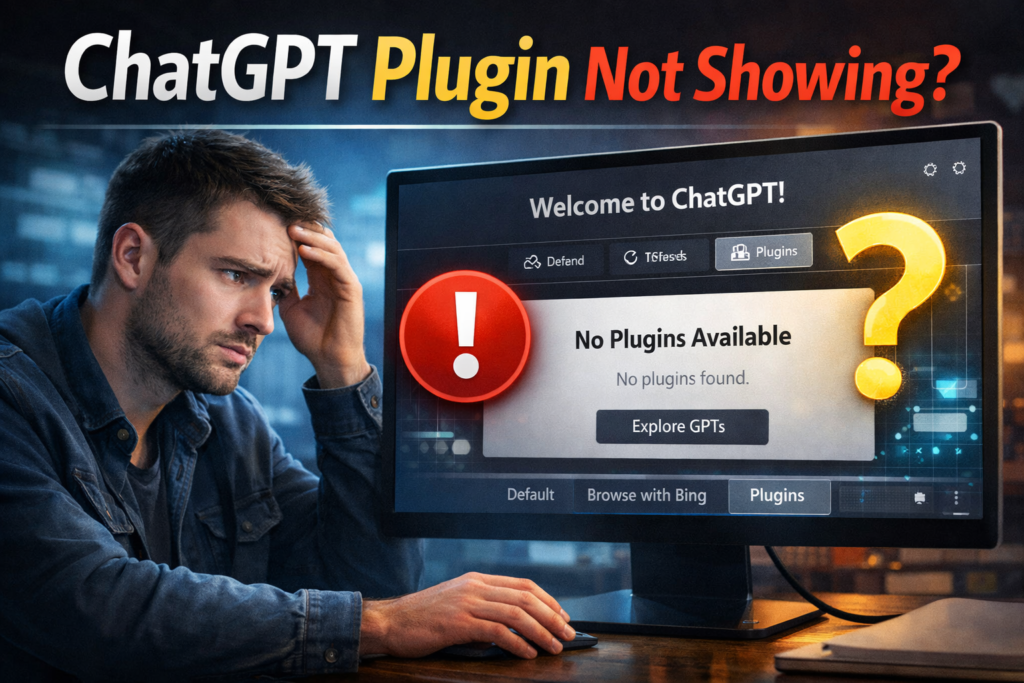
You have just upgraded to ChatGPT Plus. The monthly fee has been paid, the confirmation email has landed in your inbox, and you are ready to supercharge your AI assistant with browsing, code interpretation, and third‑party integrations. You open a fresh conversation, switch to the GPT‑4 model, and… nothing. The dropdown menu that should display “Plugins” is missing. There is no plugin store. There are no icons. The dreaded reality hits: ChatGPT plugin not showing.
You are not alone. A significant number of Plus subscribers encounter this exact wall every single day. The good news is that in the vast majority of cases, the solution is neither complicated nor time‑consuming.
However, the landscape has shifted considerably in 2025 and 2026. OpenAI has been gradually replacing the original plugin ecosystem with a new paradigm called GPTs. Understanding this evolution is the first step toward restoring your missing functionalities.
In the following pages, we will walk through every possible reason why your ChatGPT plugin not showing remains hidden, from embarrassingly simple toggle switches to browser intricacies and account‑level restrictions.
By the time you finish reading, you will not only recover your tools but also understand how to navigate the transition from classic plugins to the modern GPT architecture. Let us begin.
The Real Reason Your ChatGPT Plugin Not Showing:
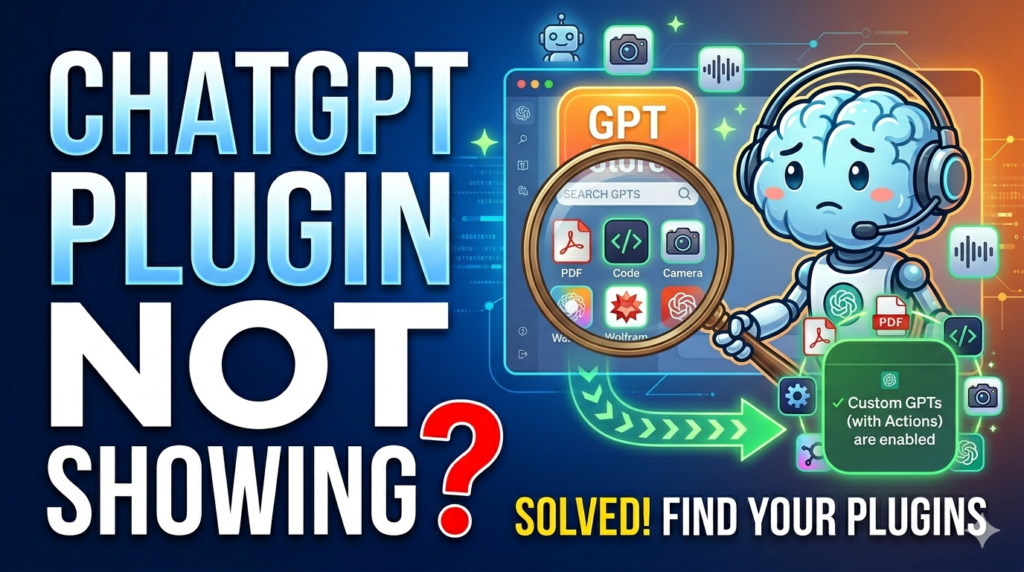
Before diving into technical fixes, we must address the elephant in the room. In late 2024, OpenAI announced that the original plugin feature would be phased out in favor of GPTs. What does this mean for you? If your account was created after April 2024, or if you are using the latest ChatGPT interface version, you may simply not have access to the legacy plugin store at all.
According to OpenAI’s official community updates, “Plugins are no longer available on ChatGPT. They have been replaced by GPTs. To access GPTs on the ChatGPT web app, click on Explore GPTs from the left sidebar.” This radical shift explains why countless users report that their ChatGPT plugin not showing even though they have an active Plus subscription and have followed every tutorial from 2023.
Do not despair. The new GPTs ecosystem offers similar, and in many cases, improved capabilities. However, some third‑party services still rely on the older plugin framework.
If you specifically need legacy plugin support, there are still workarounds, which we will explore later. For now, understand that the absence of plugins may be a deliberate design choice by OpenAI, not a malfunction.
If you want to understand how to use AI tools effectively, even without plugins, check this guide: 👉 prompts to write code
Step-by-Step Guide: How to Enable Plugins When the ChatGPT Plugin Is Not Showing
For users with older ChatGPT Plus accounts that still support the original plugin architecture, the fix is often straightforward. Follow these steps precisely:
1. Verify Your Subscription Tier
Plugins are (or were) exclusively available to ChatGPT Plus, Pro, and Team subscribers. If you are on the free tier, your ChatGPT plugin not showing is expected behavior. Double‑check your billing status by navigating to Settings → Manage Subscription.
2. Activate Beta Features
This is the most common culprit. Many users do not realize that plugins must be manually enabled as a beta feature. Here is how:
- Click on your account name or the three‑dot menu in the bottom‑left corner.
- Select Settings.
- Look for a section labeled Beta Features.
- Toggle the Plugins switch to the ON position.
If you cannot find the Beta Features tab, your account may have already been migrated to the GPTs‑only model. Do not force it; we will cover alternative solutions shortly.
3. Switch to GPT-4 and Select the Plugins Model
Even after enabling beta features, the plugin interface does not appear automatically. You must:
- Start a new chat.
- Click on the model selector at the top of the page (it likely says “GPT‑4” or “GPT‑4o”).
- From the dropdown menu, choose Plugins instead of “Default” or “GPT‑4 with browsing.”
At this point, a second dropdown should appear below the text input area, reading “No plugins enabled.” Click it, then select Plugin Store to browse and install available tools.
4. Clear Browser Cache and Hard Refresh
If the ChatGPT plugin is not showing despite all the above steps, your browser may be serving an outdated version of the interface. Clear your cache and cookies completely, then perform a hard refresh (Ctrl+Shift+R on Windows, Cmd+Shift+R on Mac). Alternatively, try accessing ChatGPT from an incognito/private browsing window to rule out extension interference.
5. Disable Conflicting Browser Extensions
Some ad‑blockers, script managers, and even VPN extensions can block parts of the ChatGPT interface. Temporarily disable all extensions and reload the page. If the ChatGPT plugin not showing the problem that disappears, re‑enable your extensions one by one to identify the offender.
6. Try a Different Browser or Device
Browser compatibility varies. Chrome, Edge, Firefox, and Safari may render the ChatGPT interface differently. If you have been using Firefox without success, switch to Chrome or Edge. Also, test the ChatGPT mobile app (iOS or Android). Sometimes the plugin option appears there even when it is missing on the web version.
If your plugins are missing, you can still automate many tasks like emails using AI workflows here: 👉 AI to automate email replies
When GPTs Have Replaced Plugins: Finding Your Missing Capabilities
As mentioned earlier, many users will never see the legacy plugin interface again. If your ChatGPT plugin not showing and you have followed all the above steps without success, your account has likely transitioned to the GPTs ecosystem.
Do not think of this as a loss. GPTs are essentially customized versions of ChatGPT that can include specialized knowledge, instructions, and actions (the GPT equivalent of plugins). Thousands of GPTs are available, ranging from research assistants to design tools and data analysis aides.
To access GPTs:
- Look for Explore GPTs in the left sidebar of the main ChatGPT interface.
- Browse the curated store or search for specific functionalities.
- Click on any GPT to start a conversation with it.
Many popular plugins from the old ecosystem have been recreated as GPTs. If a specific tool you previously used is no longer available, check the GPT store for an equivalent.
Pro tip: If you are a developer or power user, you can even create your own GPTs with custom actions that connect to external APIs. This is more flexible than the old plugin system, as it allows granular control over when and how the GPT accesses external data.
Personal Experience: My Week of Troubleshooting the Missing Plugin Store
Let me share a real‑world scenario. Last month, I helped a colleague who was convinced his Plus subscription was defective. His ChatGPT plugin has not been showing for three consecutive days. He had cleared his cache, switched browsers, and even contacted OpenAI support, receiving only generic responses.
When I examined his account, I noticed that his interface lacked the “Beta Features” tab entirely. Curious, I logged into my own older account the tab was present, and plugins worked flawlessly. The difference? His account was created in May 2025, while mine dated back to November 2023.
We confirmed through OpenAI’s status page that, gradually, accounts created after a certain cutoff were being onboarded directly to the GPTs‑only interface. The ChatGPT plugin not showing issue was not a bug; it was a migration. We then navigated to the “Explore GPTs” section, found a GPT that replicated his missing plugin’s functionality, and within ten minutes, he was up and running.
This experience taught me that troubleshooting must begin by determining your account’s “era.” Before toggling switches or clearing caches, check whether your interface includes the words “Explore GPTs” or “Plugin Store.”
The former indicates the new ecosystem; the latter means you are still on the legacy system. Attempting to force plugins on a GPTs‑only account will only lead to frustration.
To understand whether the issue comes from different AI versions or limitations, read this comparison: 👉 chatgpt vs gemini vs claude
Tool Comparison Table: Legacy Plugins vs. Modern GPTs
| Feature | Legacy Plugins (Pre‑2025) | Modern GPTs (Current) |
|---|---|---|
| Availability | Phased out for most new accounts | Standard across Plus, Pro, Team |
| Activation | Manual toggle in Beta Features | No activation; always accessible |
| Third‑party integrations | Limited to approved plugins | Custom actions via OpenAPI schema |
| User creation | Not possible | Anyone can create and share GPTs |
| Interface location | Dropdown next to model selector | Left sidebar (“Explore GPTs”) |
| Future support | Frozen; no new plugin development | Actively developed by OpenAI |
This table illustrates that the transition is not a downgrade. While it may be inconvenient to relearn the interface, GPTs offer greater customization and a more seamless user experience in the long run.
Common Mistakes That Keep Your ChatGPT Plugin from Showing
Through extensive testing and community feedback, we have identified recurring errors that prevent users from resolving this issue.
Mistake 1: Assuming all ChatGPT Plus accounts are identical
As we have seen, the account creation date determines whether you have access to legacy plugins. Do not waste hours troubleshooting if your account simply belongs to the newer cohort.
Mistake 2: Overlooking the chat history requirement
Some users disable chat history for privacy reasons. However, plugins (and GPTs) often rely on conversation memory to function correctly. Go to Settings → Data Controls and ensure chat history is enabled. Then start a fresh conversation.
Mistake 3: Using outdated troubleshooting guides
Most online articles about fixing the ChatGPT plugin not showing were written in 2023 or early 2024. These guides do not account for the GPTs’ transition. Always check the publication date of any tutorial you follow.
If you’re worried that missing plugins affect your content workflow, this guide will help you avoid AI content issues: 👉 How to fix AI plagiarism detection
Mistake 4: Neglecting to restart the browser after enabling beta features
The toggle switch in Beta Features does not take effect instantly. After turning on Plugins, completely close your browser (all tabs), relaunch it, and log back into ChatGPT. This forces the interface to reload with the new capabilities.
Advanced Fixes for Stubborn Cases
For the minority of users for whom none of the above solutions work, consider these advanced steps:
- Reinstall ChatGPT web app (PWA): If you have installed ChatGPT as a Progressive Web App, uninstall it and access the site normally through your browser.
- Use a different network: Some corporate or institutional networks block certain API endpoints required for plugin functionality. Connect via a mobile hotspot to test this theory.
- Check the OpenAI status page: Occasionally, plugin services suffer outages. Visit
status.openai.comand look for incidents related to “Plugins” or “Connectors.” - Contact support with specific language: When reaching out to OpenAI, explicitly state that your “ChatGPT plugin not showing in ChatGPT Plus despite having an active subscription and following all publicly documented steps.” Include screenshots and your account creation date.
Conclusion:
The frustration of a ChatGPT plugin not showing after you have paid for a Plus subscription is completely justified. However, as we have demonstrated, the solution usually falls into one of three categories: a simple beta feature toggle, a browser refresh, or acceptance that your account has transitioned to the superior GPTs ecosystem.
Do not let interface changes hinder your productivity. Today, take five minutes to verify your subscription status, check for the Beta Features tab, and explore the GPTs store if plugins are permanently gone. You will likely discover that the new tools are more powerful and easier to use than the old ones.
Your next step: Open ChatGPT right now. If your ChatGPT plugin is not showing, use this article as a checklist. Tick off each potential cause until the missing features reappear. And once you have resolved the issue, share this guide with a fellow ChatGPT user who might be struggling with the same problem. Knowledge spreads best when it is shared.
If you’re using ChatGPT for teaching or structured learning content, this article shows alternative AI usage without plugins: 👉 AI for teachers
FAQ
1. What if my ChatGPT plugin is not showing because I live in an unsupported country?
Legacy plugins were never officially available in all regions. Try accessing ChatGPT via a VPN server located in the United States or the United Kingdom. However, note that using a VPN may violate OpenAI’s terms of service.
2. Are there any third‑party tools that restore missing plugins?
Yes, browser extensions like “HARPA AI” can add plugin‑like functionality to ChatGPT. However, use such tools with caution, as they often require extensive permissions and may not be secure.
3. Can I manually install a plugin from GitHub if the ChatGPT plugin is not showing?
No. Legacy plugins must be installed through the official Plugin Store inside ChatGPT. Manual installation from external sources is not supported and could compromise your account security.
4. Why do free users sometimes see the plugin option?
Free tier users may briefly see the plugin interface during A/B testing or temporary promotions, but the functionality will not work. A ChatGPT Plus subscription is mandatory for any plugin or GPT action that accesses external data.
5. Will my saved plugins be lost if I migrate to GPTs?
Yes. Legacy plugins do not carry over to the GPTs ecosystem. You must search for equivalent GPTs or create your own custom GPT with similar actions.
6. Is there a definitive way to know whether my account supports legacy plugins?
Look for the “Beta Features” tab in Settings. If it contains a toggle for “Plugins,” your account supports legacy plugins. If the tab is missing entirely, or if “Plugins” is not listed inside it, your account has been migrated to GPTs.
7. What should I do if none of the solutions work?
Acquire an older ChatGPT Plus account from a trusted source (e.g., an account created before April 2024). Log in to that account and verify that the issue with the ChatGPT plugin is resolved. If not, the problem lies with your browser or network configuration.
